Santa Fe and Learning the Exposure Triangle
Intentionally golf-heavy
PHOTO JOURNAL 2026
James Bradley
4/9/20267 min read
Intentionally golf-heavy
Santa Fe and Learning the Exposure Triangle
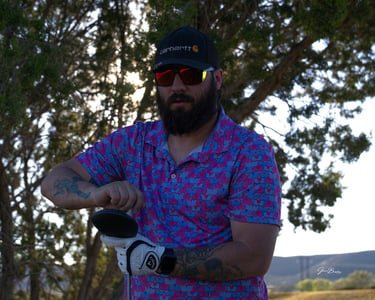
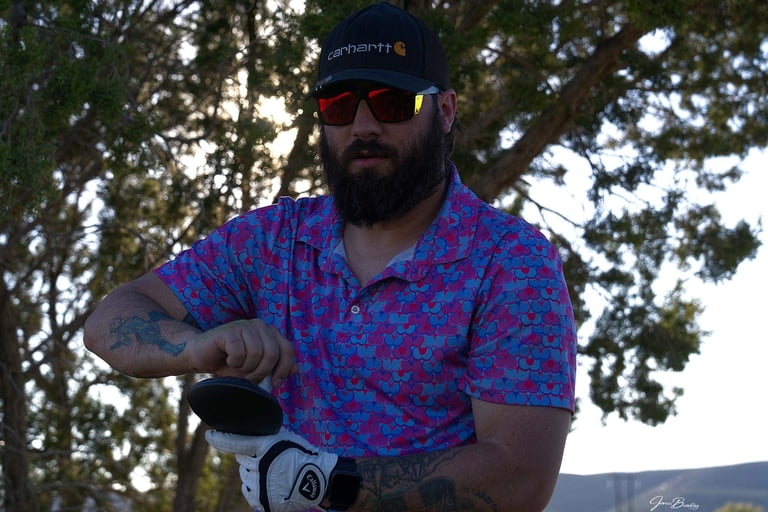
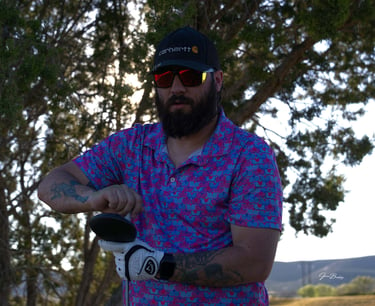
This set of photos came from a week in Santa Fe that was intentionally golf-heavy. The golfer in these photos is my son Chris, which made this set a little more personal for me. I am not complaining. Golf gave me a good chance to practice something different from wildlife, landscapes, and random “that looks interesting” photos.
At first glance, golf seems like it should be fairly simple to photograph. The golfer stands there. The ball is sits still. The course is pretty. Nobody is sprinting across a field or flying away from me like every bird I have ever pointed a camera at. Easy, right?
Nope. Not exactly.
Photographing golf has its own set of problems. The swing happens fast, the things in the background matter, the light changes across the course, and if I miss the timing, the photo can go from “majestic, athletic golf shot” to a “ WTF was that with a club” pretty quickly.
This was also a good chance for me to start paying more attention to camera settings, especially exposure (how light or dark the shot is). Up to this point in the challenge, I have been learning a little bit at a time, mostly by making mistakes and then trying to figure out what went wrong and why. With these golf shots, I had to start thinking more about the mysterious exposure triangle: aperture, shutter speed, and ISO. Is it really mysterious or am I just clueless?
This sounds fancy, but the basic idea is pretty simple. These three settings work together to control how bright the photo is and how the final image looks. As it turns out, if you adjust one, it will directly affect what the other two legs of the triangle do to the final shot.
Aperture controls how much light comes through the lens and also affects how blurry the background is. This is also where the lenses themselves start to matter. I have several lenses which have different apertures. My 30mm lens opens up to f/1.4, which lets in a lot of light and can give a very blurry background (bring on the bokeh). This one is referred to as a prime (fixed focal length) lens, which means that 30mm is the only focal length it has. There are several lengths of prime lenses, the 30mm, 50mm, and 85mm amongst them. I don’t have a much experience with the primes, but I do know I really enjoy the little that I have, but more on this in a later post.
My 24-70mm lens opens up to f/2.8, which is still pretty wide and useful for portraits, events, and a lot of general shooting. My 50-400mm lens is f/5.6-6.3, depending on how far I am zoomed in, so it does not let in as much light, but it gives me the reach I need for wildlife, sports, and subjects that are farther away. Both of these lenses are variable zoom, or telephoto lenses. Most photographers prefer this type of lens because of its versatility. There are a ton of uses for telephoto (zoom lenses) in many shooting situations. Ideally I would like to get my hands on a 70-200mm f/2.8 (Sony) because that is supposedly the best all around sports/action lens in the business, but I am not independently wealthy…maybe some day huh?
I am starting to understand that each lens has its own specialty. That being said, there is a lot of overlap in their uses. A wide aperture can help separate Chris from the background, which is useful when the course has trees, buildings, carts, bushes, and all kinds of other stuff trying to sneak into the photo. But with the longer 50-400mm lens, I have to pay closer attention to light because that lens needs more of it, especially when I am zoomed way in.
Shutter speed controls how long the camera lets light hit the sensor. A slower shutter speed lets in more light, but it can also create blur if the subject moves. A faster shutter speed lets in less light, but it helps freeze motion. For golf, this matters a lot because the swing moves fast. If the shutter speed is too slow, the club, arms, or ball can blur. Sometimes blur can be used on purpose, but at this stage I was mostly trying to keep things sharp and not make it look like Chris was swinging through a fog machine. I have learned how much of a nightmare it is to try to get the club face when it contacts the ball. I have yet to be able to get that shot. The timing is horrible, but I have a plan to remedy this (cue the evil laugh).
ISO controls how sensitive the camera is to light. In bright daylight, I usually keep the ISO lower (around 100, sometimes auto), which helps keep the image cleaner and less grainy. Indoors, in shade, early in the morning, late in the evening, or anytime the light is not great, I may need to raise the ISO so the camera can still get a properly exposed image. The downside is that higher ISO can add noise to the photo, so it is another balancing act. Low ISO is cleaner, but it needs more light. Higher ISO helps in darker conditions, but it can make the image look rougher if I push it too far.
These are the parts I am starting to understand more and more with every picture I take. Every setting affects the others. If I want a faster shutter speed, I may need to open the aperture or raise the ISO. If I want more background blur, I may open the aperture, but then I have to watch that the image does not get too bright. If I am using the 50-400mm lens zoomed in, I may need more light or a higher ISO because that lens does not open as wide as the 30mm or the 24-70mm. It is all connected, and the camera is more than happy to remind me when I get it wrong.
Full daylight was another challenge in this set. Full sun can be helpful, but it can also be harsh. Most people will struggle (pick me) with shooting in direct full sun. It creates strong shadows, a ton of blown highlights, and it turns into a complete cluster &*#$, unless I am paying attention. I am still learning how to read the light and adjust for it instead of just hoping the camera would save me. Spoiler alert: the camera rarely saves me.
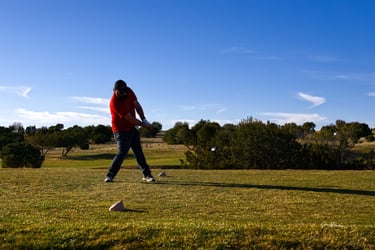
The driving and hybrid shots gave me a good chance to practice timing. I had to watch Chris set up, (see club face contact) anticipate the swing, and try to catch the motion at the right moment. Too early or too late and the whole image is completely jacked up. That was a good lesson for me because sports photography is not just camera settings. It is also learning to read what is about to happen. You know, that whole timing thing.
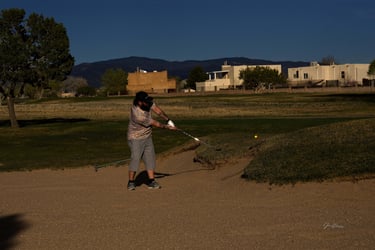
The sand trap shot is one I like because it tells a different part of the golf story. It is not just a clean tee shot or a nice putt. It is part of the game where things did not go perfectly, and now the golfer has to fix it. This is where I told Chris if he wasn’t playing in the sand, he wasn’t playing. He vehemently disagrees. I know, weird, my son disagrees with me. What a concept.
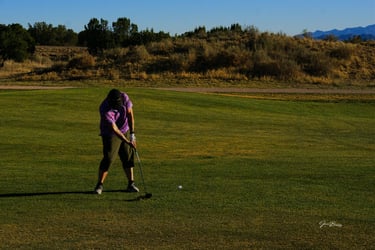
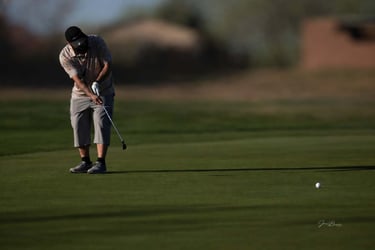
My favorite photo from this set is probably the putter shot. I like the focus, the ball sits out in front of him, the background blur that I got from having the aperture wide open (f/2.8). It has a quiet, concentrated feel to it. Golf has a lot of those little moments where everything slows down for a second, and I think this photo captures some of that.
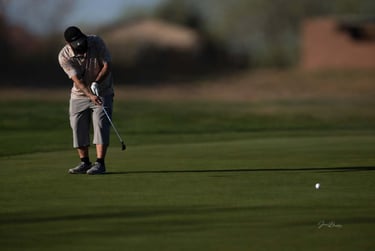
My least favorite is probably the farther-back hybrid shot. I like the idea, and I like the setting, but the boy seems a little small in the frame. It still works as part of the full set, but by itself it does not grab me as much as some of the others.
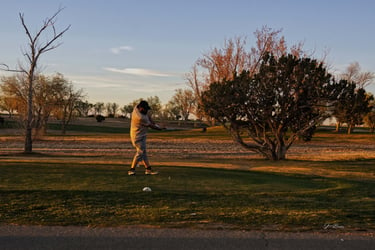
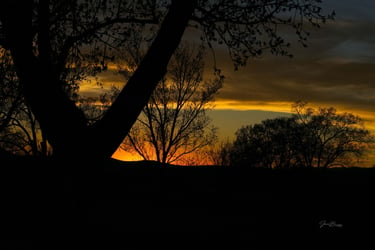
The sunset at the Santa Fe Country Club was a nice way to finish up the set. After working in full daylight and fighting with exposure, the sunset gave me a completely different kind of light to work with, which made me smile. It was softer, warmer, and way more dramatic. It also reminds me that light changes everything. Same camera, same person behind it, completely different mood.
So this set gave me a good lesson in both photography and patience. Golf helped me work on timing, composition, and exposure. Photographing Chris gave the set a little more meaning for me because it was not just practice; it was practice with someone who matters to me. The bright daylight pushed me to think harder about aperture, shutter speed, and ISO. The different lenses reminded me that the gear choice matters too because each lens handles light, distance, and background blur differently. The sunset reminded me that sometimes the best light shows up after the hard part is over.
I am still very much learning, but this feels like a good step toward understanding the camera instead of just arguing with it.
I would love to get some feedback from you all about the photography learning process. Please feel free to shoot me an email through my contact page.
Thanks for reading!
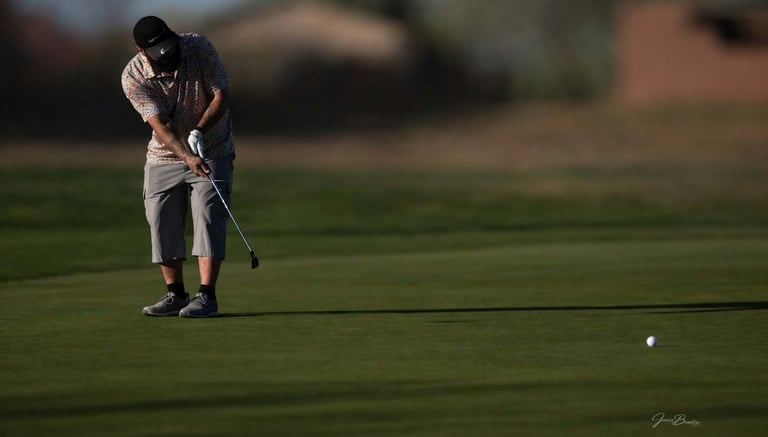
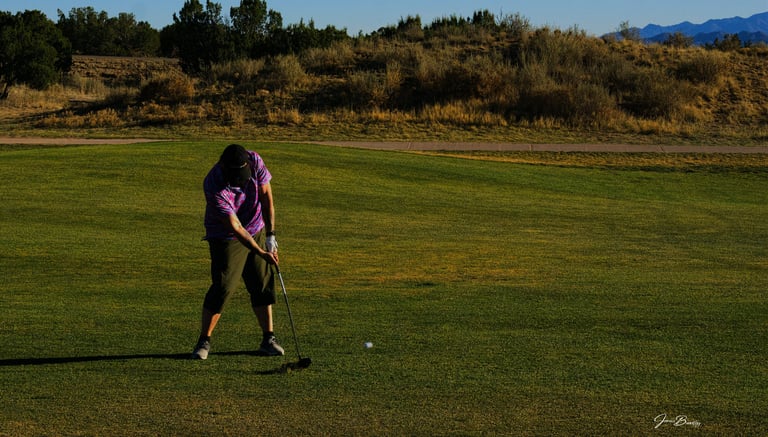
The Putter
Hybrid Shot